Murat Pasha Mosque — A Bursa-Style Icon at a Crossroads in Istanbul
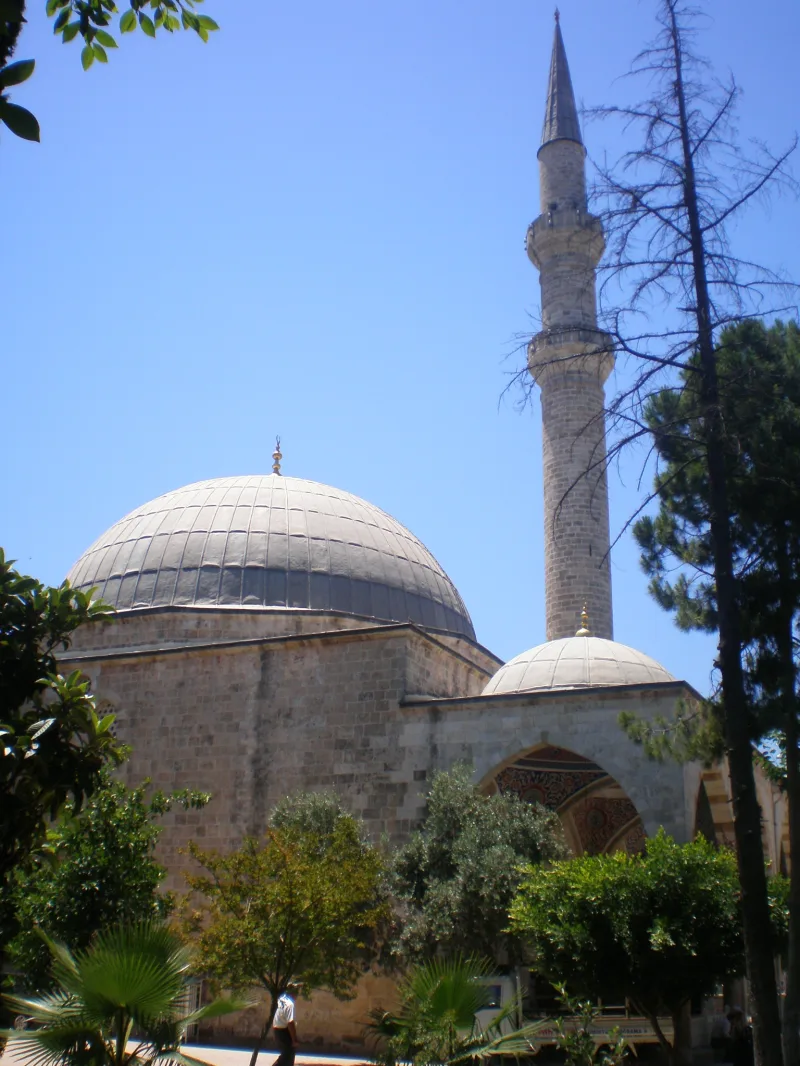
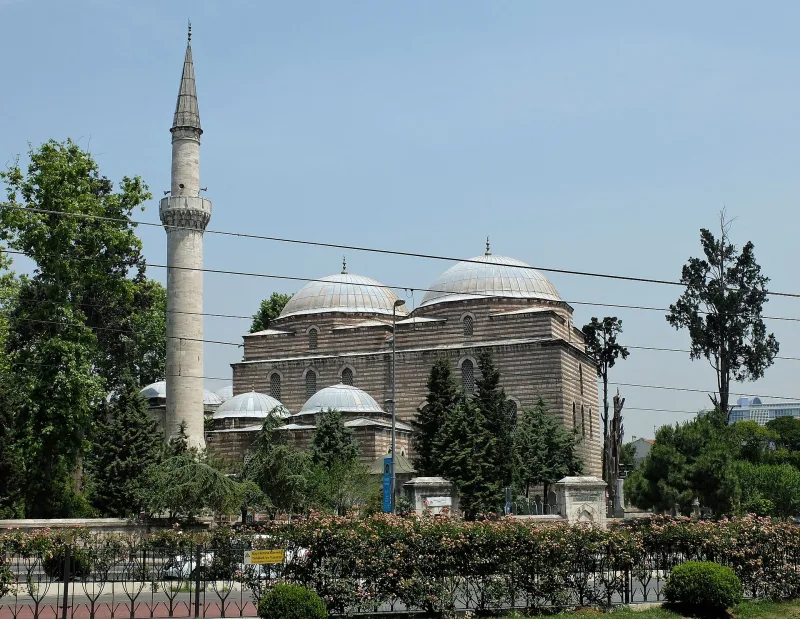
At the bustling intersection of Aksaray and Yusufpaşa streets in the Fatih district, where two multi-lane highways squeeze the space to a minimum, stands a building that you hardly notice at first glance—and cannot forget afterward. The Murat Pasha Mosque (Murat Paşa Camii) is a 15th-century Ottoman mosque, squeezed between modern thoroughfares, like a fragment of another time that has survived in defiance of urban progress. Built in 1465–1466 by order of Hass Murad Pasha and completed by his brother Mesih Pasha, the Murat Pasha Mosque represents the early Ottoman style refined in Bursa—a double-domed prayer hall, a narthex in the spirit of Byzantine churches, and a portico, which together create a remarkable sense of transition between worlds and eras.
History and Origin of the Murat Pasha Mosque
Hass Murad Pasha (also Has Murat Paşa) is a figure whom history has noted sparingly but significantly. He commissioned the construction of the mosque in 1465–1466, but did not live to see it completed. His brother Mesih Pasha took over the completion of the project and was later buried here. This circumstance is remarkable in itself: the mosque became a family project passed from brother to brother—a rare example of a collective commission in early Ottoman architecture.
Both brothers are associated with the turbulent period of the first decades following Mehmed II’s conquest of Constantinople (1453). The city was undergoing active reconstruction; the new imperial capital was sprouting with mosques, madrasas, and bathhouses. The construction of Murat Paşa Camii fits into this wave: Fatih and the surrounding neighborhoods were actively being built up precisely in the 1460s and 1470s. In his *Documenta Islamica Inedita* (1952), German historian Franz Babinger mentions a property document related to Hass Murad Pasha, dated December–January 1471–72—after the mosque had already been built.
In his monograph *The Sultan of Vezirs* (2001), Theodor Stavrides examines the entourage of Grand Vizier Mahmud Pasha Angelović (1453–1474)—a contemporary and political partner of Hass Murad Pasha in early-Ottoman Istanbul. This indirectly confirms the high standing of the mosque’s patron at the court of Mehmed II. The origins of Hass Murad Pasha himself remain a matter of debate, but his proximity to the imperial center of power is beyond doubt.
The building was originally part of a kulliye—a religious and charitable complex. Today, only the mosque itself and fragments of its hazine (treasury) remain from this complex. The other structures did not survive—they were swallowed up by successive waves of urban development.
Architecture and What to See
Murat Paşa Camii is an example of the “Bursa school” of early Ottoman architecture, sometimes also referred to as the “inverted T-plan” (ters T plan şeması). This architectural tradition emerged in the 14th–15th centuries in Bursa and was later transferred to conquered Constantinople.
Double-domed prayer hall
The main space of the mosque is a 2:1 rectangle covered by two identical domes—each 21 meters high and 10.5 meters in diameter. The mihrab (prayer niche) and minbar (pulpit) are located on the short side of the rectangle. This layout is atypical for late Ottoman domed mosques with a single large dome—it indicates an intermediate stage of development, when the mosque had not yet become a unified space under a single vault but tended toward separate compartments.
The Narthex and Its Connection to Byzantium
In front of the prayer hall is a narthex—an entrance vestibule—whose layout resembles the narthexes of Byzantine churches. This is a direct parallel: early Ottoman architects in Constantinople consciously or intuitively reproduced the Byzantine spatial solutions they saw around them. The narthex precedes the portico—an external covered gallery opening onto the courtyard.
Materials and Construction
The mosque’s walls are constructed using the almaşık technique: an alternation of two rows of brick and one row of hewn stone. This striped masonry is one of the distinctive features of early Ottoman architecture, inherited from the Byzantine building tradition. The portico’s columns vary in height and are made of different materials—evidence of the use of spolia (building stone from earlier structures). The marble portals are distinguished by their restrained forms: they are tall, simple, and devoid of excessive decoration. The windows lack stained glass; the upper windows are round and do not open, while the lower ones are rectangular and casement-style. The domes rest on pendentives with muqarnas decoration—honeycomb-like stalactites characteristic of the Islamic architectural tradition.
Two side mihrabs
An interesting detail: the main prayer hall (son cemaat yeri, portico) features two small mihrabs—one on each side. This is an unconventional design, uncommon in most mosques, and its practical purpose remains unclear.
Interesting facts and legends
- The mosque was begun by Hass Murad Pasha and completed by his brother Mesih Pasha—it was the brother, not the patron, who was subsequently buried here.
- The building was part of a kulliye—an entire religious complex. Only the mosque and fragments of its treasury have survived to this day; the rest of the structures were absorbed by the city.
- The mosque’s narthex resembles the narthexes of Byzantine churches in structure—this is not a coincidental similarity, but a deliberate borrowing from the architectural tradition of the recently conquered Constantinople.
- The columns of varying heights and materials in the mosque’s portico are spolia: building stone taken from earlier, pre-Ottoman structures. This practice was widespread in 15th-century Istanbul.
- Murat Paşa Camii is sandwiched between two modern thoroughfares—Aksaray and Yusufpaşa—and is effectively situated on an architectural “island”: the surrounding area has changed radically, while the mosque itself has remained almost untouched.
How to get there
The mosque is located in the Fatih district of Istanbul’s historic center, at the intersection of the roads leading to Aksaray and Yusufpaşa. The nearest T1 tram stop is Aksaray, about a 5-minute walk away. The T1 tram line connects Aksaray with Sultanahmet, Sirkeci, and Beyazıt—the main tourist attractions in the historic part of the city.
By metro: M1 line (Istanbul Metro) — Aksaray station. To Istanbul Airport (IST) via Gayrettepe — about 1 hour; to Sabiha Gökçen Airport (SAW) via Kadıköy — about 1.5 hours. From the Sultanahmet district to the mosque by taxi—about 10 minutes depending on traffic. On foot from the Blue Mosque (Sultan Ahmed Camii)—about 20–25 minutes along Millet Caddesi.
Tips for travelers
Murat Paşa Camii is not a “top-tier” tourist mosque like the Blue Mosque or Süleymaniye, but an authentic 15th-century neighborhood landmark. That’s precisely why it’s rarely crowded: come and take your time exploring the interior and soaking up the authentic atmosphere of early Ottoman architecture without the tourist hustle and bustle.
Admission is free; please remove your shoes at the entrance. Take note of the almashik masonry on the exterior—this is where brick and stone alternate in a striking and photogenic pattern. Inside, you’ll find dim lighting, muqarnas vaults, and two domes: give your eyes a moment to adjust. The best time to visit is on weekday mornings, when there are few worshippers and you can take your time examining the details.
Combine this with a tour of Fatih: nearby are the Fatih Camii Mosque (Mehmed II Complex), Aksaray Square, and the Valens Aqueduct. Take your time: Fatih is a district where a single block can hold fifteen centuries of history. For Russian-speaking tourists, it’s convenient to fly into Istanbul Airport (IST), from where you can take the M1 metro to Aksaray—a direct route with no transfers. If you want to see the Murat Pasha Mosque at its best, come in the morning when the sun illuminates the western facade and the city hasn’t yet become bogged down in traffic.